
npm Worm in binding.gyp: Securing CI/CD Pipelines Against Build-Time Supply Chain Attacks
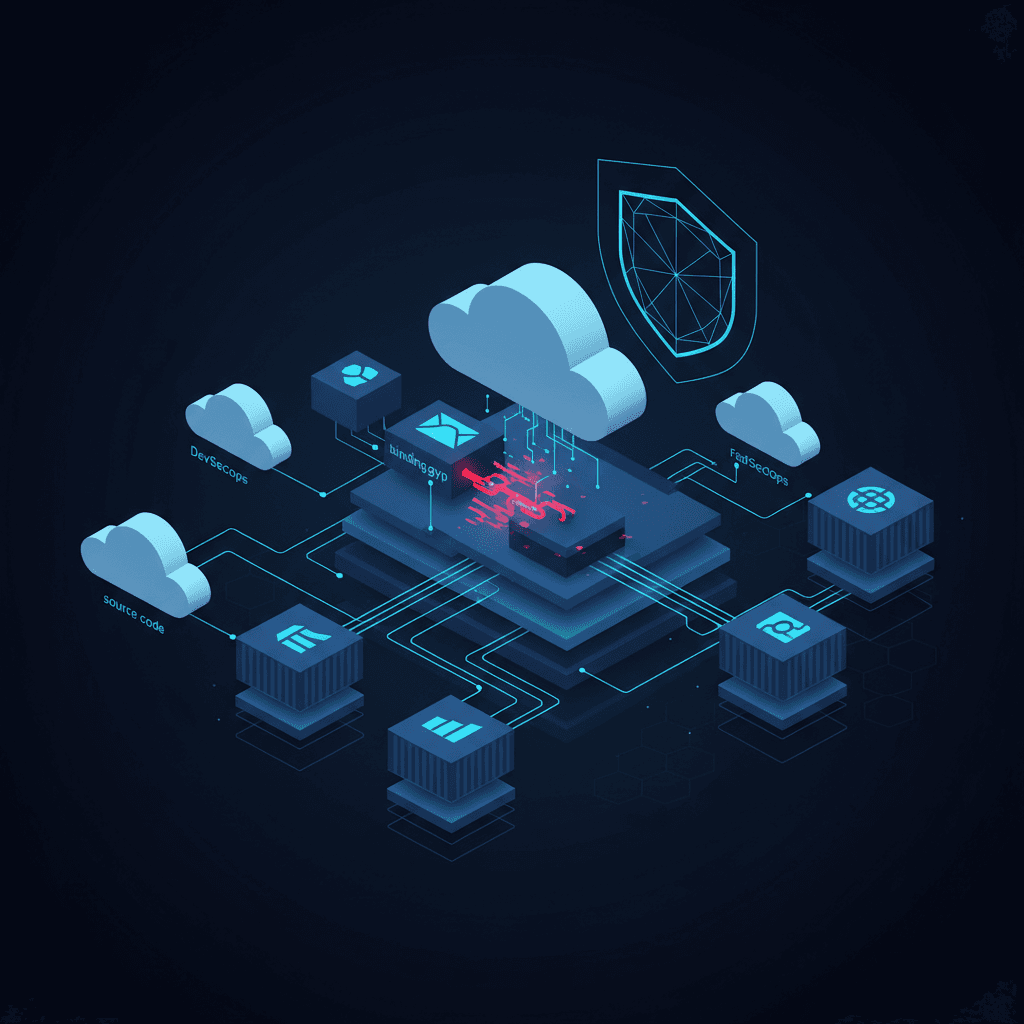
A self-propagating npm worm that hijacks node-gyp build scripts represents a new class of supply chain threat — one that activates inside your CI/CD pipeline at container image build time, not at package install. For cloud architects and compliance officers, this is not a developer-only problem. It is a pipeline-integrity failure that can inject malicious code into production container images before they ever reach a registry, bypassing traditional runtime security controls entirely.
Why Build-Time Compromise Changes the Threat Model
The node-gyp worm hides inside binding.gyp, the native addon build configuration file that executes arbitrary commands during npm install. Unlike a post-install script that runs on a developer workstation, binding.gyp executes inside your CI build environment — the same environment that produces signed, scanned container images. A compromised build step means the resulting image artifact is tainted at the source. Standard image scanning catches known CVEs in layers, but a worm that propagates by publishing new malicious packages to npm during the build creates a moving target that signature-based tools miss.
Dependency Reachability as a Control Point
Not every declared dependency is actually imported by application code. CloudReviewer's dependency reachability analysis maps the full transitive dependency graph against actual import paths, identifying packages that exist in lockfiles but are never loaded at runtime. In the context of a self-propagating worm, this analysis surfaces packages that were pulled in as transitive dependencies of build tools — exactly the class of packages that binding.gyp-based malware exploits. By flagging unreachable or suspiciously deep transitive dependencies before the build starts, teams can shrink the attack surface that node-gyp and similar build systems can reach.
SLSA Provenance and SBOM Integrity for FedRAMP Workloads
NIST SP 800-190 explicitly calls out build pipeline compromise as a container supply chain risk, and FedRAMP-aligned environments are expected to enforce build integrity controls under the system and communications protection family. SLSA Level 2+ requires tamper-proof provenance attestation for build artifacts. When a worm modifies build behavior mid-pipeline, the resulting image no longer matches the attested SBOM. CloudReviewer integrates SBOM generation with build-pipeline integrity checks, comparing the resolved dependency tree at build time against the declared SBOM. A divergence — such as a new package injected by a worm during the build — breaks the provenance chain and blocks promotion to production registries.
CSA CCM Controls for CI/CD Pipeline Security
The CSA Cloud Controls Matrix maps CI/CD pipeline security to controls under the governance and risk management domain, including continuous integrity monitoring of build environments. A self-propagating worm that publishes new packages during a build run violates the assumption that the dependency graph is static between lockfile commit and image push. CloudReviewer addresses this by enforcing dependency freeze verification at the CI gate: any package resolution that deviates from the committed lockfile triggers a pipeline failure, preventing the worm from introducing new artifacts into the build.
Blast Radius in Cloud-Native Stacks
Transitive dependencies in cloud-native stacks routinely reach depths of five or more levels. A single compromised build-tool dependency can propagate through dozens of downstream packages before any human reviews the change. In a multi-service architecture sharing base images, one tainted build can cascade across every service that inherits from that layer. This amplification effect is what makes build-time supply chain attacks a cloud-native crisis rather than an application-level vulnerability.
CloudReviewer provides the dependency reachability analysis, SBOM integrity verification, and build-pipeline policy enforcement that cloud architects and security teams need to block self-propagating supply chain malware before it reaches production. If your CI/CD pipeline builds container images from npm-based workloads, schedule a pipeline security assessment with our team to evaluate your exposure to build-time compromise.